

So, they injected it into the military, police, emergency services…. Now everyone is injected with a device with a “real IP ADDRESS”…. Thanks for reading OUTRAGED’s Newsletter! Subscribe for free to receive new posts and support my work. 0:00 Thank you very much. So one word of notice before we begin,
— Read on outraged.substack.com/p/the-emergence-of-nanobot-society
The emergence of nanobot society

So, they injected it into the military, police, emergency services…. Now everyone is injected with a device with a “real IP ADDRESS”….
0:00
Thank you very much. So one word of notice before we begin,
0:03
all the technologies that you are going to see here now are real.
0:06
And with that said
0:07
I’d like to first tell you the story about
0:10
this uh… little girl named Dana
0:12
she’s very special for me because she’s my daugther
0:14
and Dana was born with a leg condition requiring frequent surgeries like this one
0:19
uh… she had when we were in Boston
0:21
and um… I remember taking her to that particular surgery
0:25
and uh…
0:26
I rembember her being admitted and she was excited at first
0:31
and then just before they got into her the OR
0:33
I looked at her and she was… afraid, she was little worried and
0:38
who wouldn’t be? Because surgeries today are complicated
0:41
and they’re often very risky.
0:42
Now let’s imagine a few years into the future, into the near future hopefully,
0:47
Dana will arrive to hospital for her ??? surgery
0:50
and instead of being prepped for anesthesia for the OR
0:54
the surgeon will just take a syringe and inside the syringe
0:58
there are millions of tiny robots, of tiny machines
1:02
that will be injected into Dana’s bloodstream.
1:04
They will autonomously locate the place they need to be in,
1:08
they will excite out the injured tissue,
1:11
then will remove dead cells,
1:13
then they will…
1:14
stimulate and guide the regrowth of healthy cells across those tissue gaps,
1:18
they will release drugs that relief pain and reduce inflammation
1:23
and all the while Dana will be sitting on the chair
1:25
eating a sandwich, reading a book, might be the next
1:28
twilight saga book which she’ll be able to read because she will be 16 by then
1:32
And…(giggles)
1:33
uh… when these robots
1:35
have completed their job they’ll simply disintegrate
1:39
and disappear from her bloodstream the next day.
1:42
So these nanobots have been envisioned in the past 30 years
1:45
by people like Eric Drexler, Robert Freitas and Ray Kuzweil.
1:49
Today I’m going to show you that these robots exist
1:51
here in Israel.
1:54
I’ll show you this syringe
1:56
which I’ve brought from my lab.
1:58
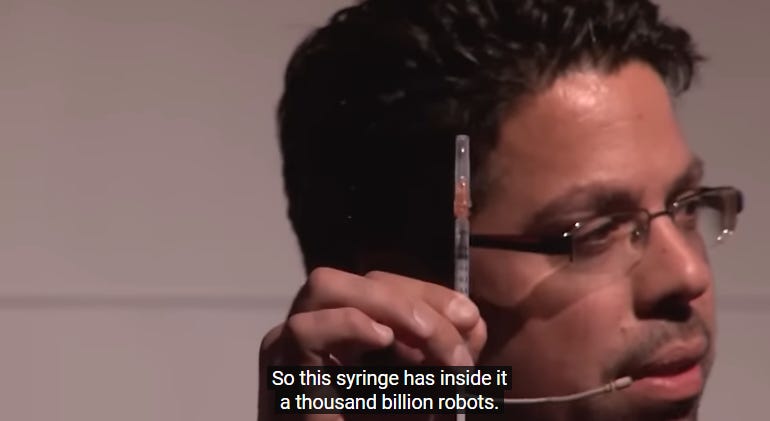
So this syringe has inside it a thousand billion robots.
2:03
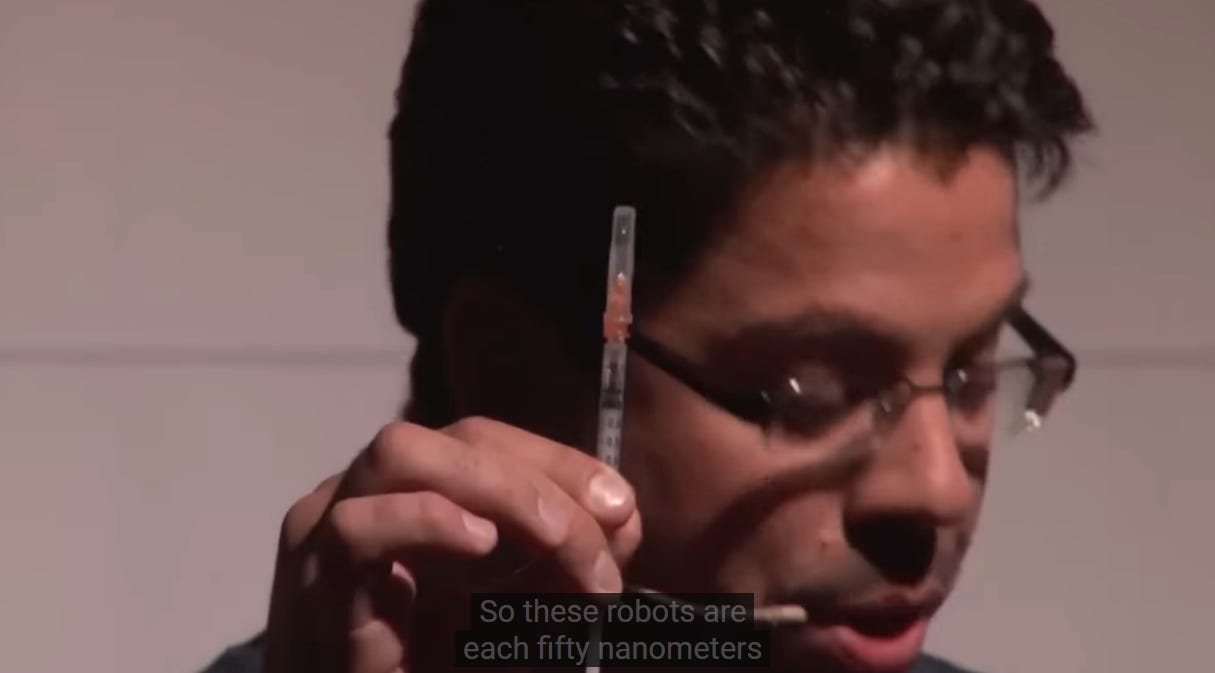
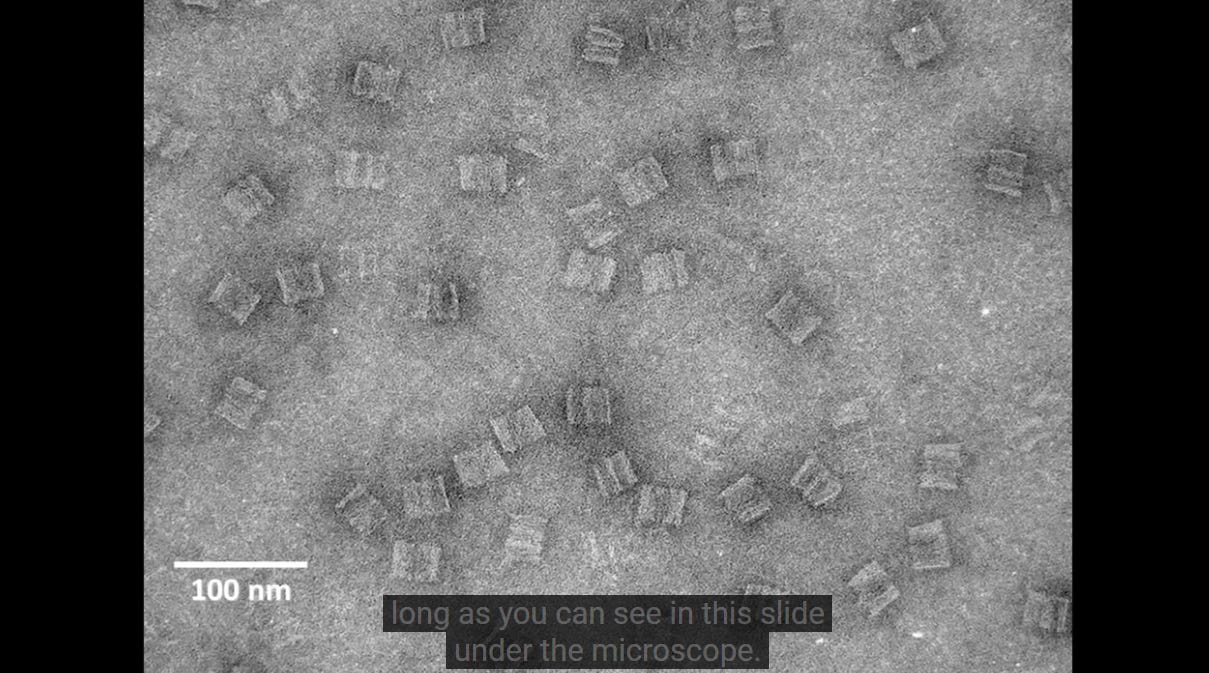
So these robots are each fifty nanometers
2:06
long as you can see in this slide under the microscope.
2:11
Fifty nanometers is about 2000 times thinner than the thickness of your hair
2:16
OK? And… umm… These robots were born actually 3 years ago
2:20
in a research I did with Shawn Douglas, now a UCSF Professor.
2:24
But over the past year and a half
2:25
in my group at Bar-Ilan University
2:27
We’ve been developing and testing robots for a variety of
2:31
medical and therapeutic tasks.
2:33
We’ve invented ways of making them safe for use
2:37
and non-inmunogenic
2:38
and we learned how to tune their stability in our bloodstream
2:41
to fit either short-term or long-term
2:44
even days long medical procedures.
2:47
So to carry out medical and therapeutic procedures in our body
2:50
with the upmost precision,
2:51
we need to be able to control molecules
2:53
Controlling molecules is a very simple challenge
2:56
in modern scientific knowledge.
2:58
OK? Let’s speak for example about the class of molecules we know as drugs
3:02
So despite…
3:04
amazing progress made in the past four decades
3:06
the way we think about drugs and we the way we use drugs
3:09
has been essentially unchanged
3:11
and it’s similar as two hundred years ago
3:14
right? You hear about about big pharmaceutical companies
3:17
spending huge amounts of money
3:19
searching for better, safer drugs.
3:22
Attempts that usually fail.
3:24
OK? but,
3:25
searching for let’s say a safer cancer drug,
3:28
half it is a concept that has a flaw in it.
3:30
Because searching for a safer cancer drug
3:32
is basically like searching for a gun that kills only bad people
3:36
We don’t search for such guns,
3:37
what we do is training soldiers to use that gun properly
3:42
Of course in drugs we can’t do this because it seems very hard
3:45
But there are things we can do with drugs
3:47
for example, we can put the drugs
3:49
in particles from which they difuse slowly.
3:51
We can attach a drug to a carrier
3:54
which takes someplace but, this is not real control.
3:57
When we were thinking about control we’re thinking about
4:00
processes is the real world around us
4:02
and what happens when we want to control a process
4:06
that’s beyond our capabilities as humans
4:08
we just connect this process to a computer
4:10
and let the computer control this process for us.
4:13
OK? So that’s what we do.
4:15
But obviously this cannot be done with drugs because
4:19
the drugs are so much smaller than the computers as we know them
4:23
The computer is in fact so much bigger
4:25
it’s about a hundred million times bigger that any drug molecule.
4:28
Our nanobots which were in the syringe
4:31
solve this problem because they are in fact
4:34
computers the size of molecules.
4:36
and they can interact with molecules
4:38
and they can control molecules directly,
4:40
so just think about all those
4:42
drugs that have been withdrawn from the market
4:45
for excessive toxicity
4:46
right?
4:47
It doesn’t mean that they are not effective,
4:49
they were amazingly effective,
4:51
they were just guns shooting in all directions
4:53
but in the hands of a well-trained soldier
4:56
or a well-programed nanobot
4:58
using all the existing drugs
5:01
we could hypothetically kill almost any disease.
5:05
So we might not need even new drugs.
5:07
We have amazing drugs already,
5:09
we just don’t know how to control them, this is the problem
5:11
and our nanobots…
5:13
hopefully solve this problem and I’ll show you how.
5:15
So there is an interesting question “how do we build
5:19
a robot or a machine the size of a molecule?”
5:21
so the simple answer would be: we can use molecules
5:25
to build this machine.
5:26
So we’re using molecules, but we’re not using just any molecule.
5:30
We’re using the perfect, most beautiful molecule on earth, at least in my opinion,
5:34
which is DNA.
5:36
And in fact every part of the robot,
5:38
every part of out nanorobots:
5:40
Moving parts, axis, locks, chasis, software,
5:44
everything is made from DNA molecules.
5:46
And the techonology that enables us to do this
5:49
originated thirty years ago when the pioneering works of Nadrian Seeman,
5:52
culminating 7 years ago in the works of Paul Rothemund from Caltech,
5:56
which was also featured in TED,
5:58
and it’s called DNA origami.
5:59
Now in DNA origami we do not use a piece of paper,
6:02
we use a single long strand of DNA
6:05
and we fold it into virtually any shape we want.
6:08
For example these shapes, so these are actual microscopic images
6:12
of shapes the size of molecules that were folded from DNA.
6:16
so the smiley you see here in the center of the screen for example
6:19
are a hundred nanometers in size
6:21
and we make billions of them in few… in a single reaction.
6:24
Now since 2006 several researchers, really talented ones,
6:28
have been expanding the limits of the technically feasible in DNA origami
6:32
and now we have an astonishig array of shapes and objects which we can build
6:35
using this technique.
6:36
And these researchers also gave us computer-aided design tools
6:41
that enable everyone
6:43
very very simply to design objects from DNA
6:46
So these CAD tools amazingly
6:49
enable us to focus o n the shape we want
6:52
forge
 donshafi911