

By Mavi Boncuk
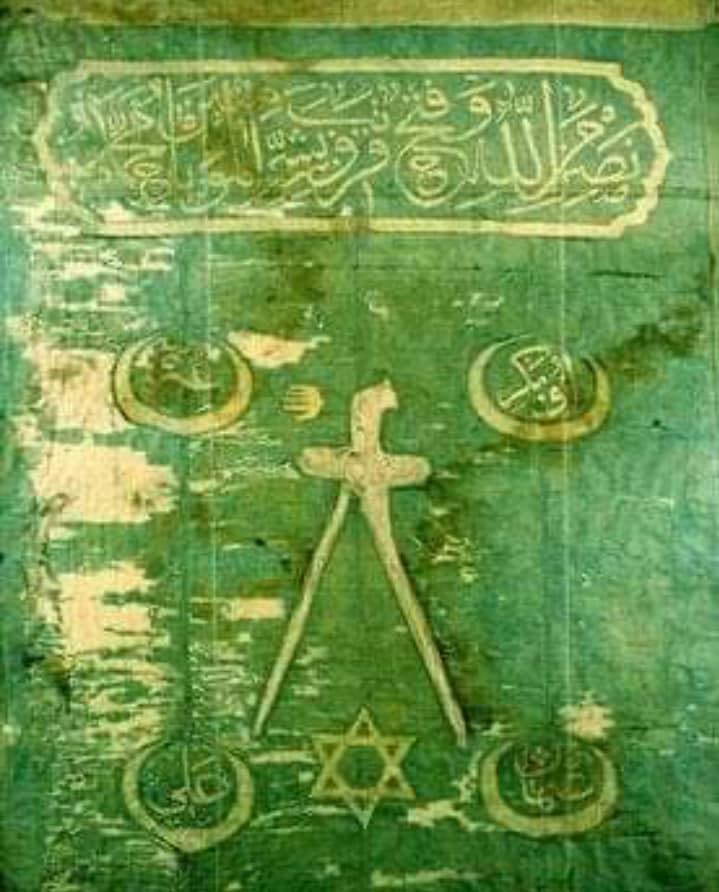
⚡ Hayreddin Barbarossa’s flag ⚡
The most interesting part of Hayreddin Barbarossa’s flag is that it bears symbols of Judaism, Christianity and Islam (the 3 “ehl-i kitab” religions sent by Allah, according to Islam).
The flag carries the “Fetih” Chapter from the Koran, below it inside crescents are the names of the four Caliphs, at the middle the Christian symbol of the Trinity, at its left the divine hand of God, and at the lower center the Jewish Star of David. This symbolism is a reflection of the Ottoman admiral’s acceptance of sheltering the three prime religions of the 16th-century Mediterranean.
Hayreddin Barbarossa was the greatest, most greatly feared, and most successful of all the Ottoman Naval warriors. Originally from Mytilene, aka Midilli (Lesbos), he and his brother Oruç had established themselves as successful privateers against Christian targets by 1512, when Sultan Selim I came to power.
Hayreddin had two memorable naval encounters with the Genoese Admiral Andrea Doria — and, although under somewhat unclear circumstances, Hayreddin bested the Italian both times. He died in 1546 (of natural causes) and was succeeded as Kapudan Paşa by Turgut Reis (Turgut Paşa). Piri Reis was a nephew.
His father was Yakup Ağa (formerly from Vardar near Selanik), one of the guardians that Sultan Mehmed II left after he conquered Midilli (Lesbos) in 1462.
His mother was a spoil of war from among the inhabitants of the conquered island — granted to Yakup by Sultan’s decree.
Four sons resulted from their union — Ishak was the oldest, next came the firebrand Oruç (Aruj), then HIZIR [Hayreddin’s given name], and then Ilyas.
He spoke all the main Mediterranean languages — Greek, Arabic, Spanish, Italian and French. And he loved music.
#c/p..Bahar🇲🇾
 donshafi911